Visualizing the Groove: A Practical Look at Music Festival Poster Scenes
In the crowded landscape of event promotion, the first point of contact between an organizer and a potential attendee is almost always visual. Whether it is a social media scroll, a physical bulletin board, or a website banner, the imagery must convey the atmosphere of the event instantly. This is where specialized assets like Music Festival Posters Scenes become indispensable tools for creators. These are not merely static images; they are comprehensive design ecosystems built to capture the essence of live performance, specifically targeting genres like jazz, rock, and blues with a distinct vector cartoon flat style.
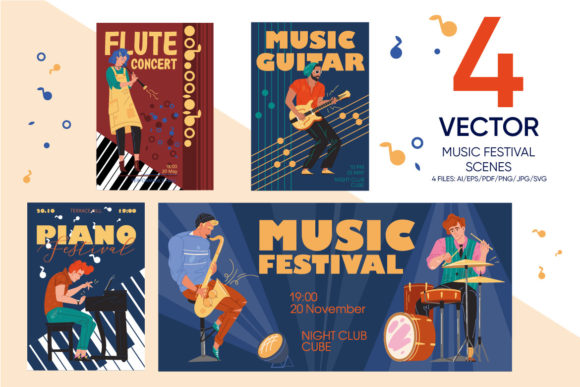
For professionals ranging from marketing agencies to independent musicians, understanding the utility of these pre-designed scenes is crucial. They represent a shift away from generic stock photography toward stylized, cohesive illustration that offers both flexibility and brand consistency. By utilizing a set of four distinct vector scenes featuring musicians playing saxophones, drums, pianos, and guitars against abstract backgrounds, designers can rapidly deploy high-quality promotional materials without the logistical nightmares of organizing a photoshoot or commissioning custom illustrations from scratch.
The Strategic Value of Vector Flat Design
The core strength of this specific collection lies in its adherence to the vector cartoon flat character aesthetic. In modern web and print design, flat design has endured because of its clarity and scalability. Unlike complex 3D renders or grainy photographs, flat vector art communicates ideas quickly. The human brain processes simplified shapes and bold colors faster than detailed textures, making these posters highly effective for digital advertising where attention spans are fleeting.
When evaluating the Musical poster concepts within this set, one notices the deliberate absence of clutter. The characters are stylized yet recognizable, embodying the "cool" factor associated with night clubs and concert halls without relying on clichéd tropes. The abstract backgrounds serve a dual purpose: they provide visual interest and depth without competing with the essential text information—date, time, venue, and ticket price. This balance is often difficult to achieve in custom designs but is baked into the composition of these scenes.
Furthermore, the vector format (Ai, Eps, Svg, Pdf) ensures that the artwork is resolution-independent. For a small business owner printing flyers for a local jazz bar or a festival promoter creating massive outdoor banners, the ability to scale graphics without pixelation is non-negotiable. High-resolution raster formats like Png and Jpg are included for immediate use, but the underlying vector data allows for infinite customization. You can alter the size of the saxophone player or the drum kit to fit a vertical Instagram story or a horizontal website header without any loss of quality.
Breakdown of the Four Key Scenes
This collection is structured around four primary instrumental focuses, each catering to different sub-genres and moods within the broader spectrum of live music. Understanding the specific application of each scene helps in selecting the right asset for a specific campaign.
- The Saxophone Scene: Typically associated with jazz and blues, this scene features a musician playing the sax against an abstract background. It evokes sophistication and late-night ambiance, making it ideal for lounge events, dinner theaters, or upscale cocktail parties. The curvature of the instrument adds a dynamic flow to the composition that guides the viewer's eye.
- The Drum Kit Scene: Rhythm is the heartbeat of rock and funk. This poster scene captures the energy of percussion, suitable for high-energy rock concerts or dance nights. The geometric representation of drums and cymbals creates a sense of movement and volume, signaling to the audience that this event will be loud and lively.
- The Piano Scene: Often the centerpiece for classical crossover, jazz trios, or solo acoustic nights. The musician playing the piano instrument on an abstract background suggests intimacy and technical skill. This asset works exceptionally well for seated events or venues focusing on musical craftsmanship.
- The Guitar and Flute Scenes: Completing the quartet, these instruments broaden the genre reach. The guitar is universal for rock, pop, and folk, while the flute adds a unique texture suitable for fusion or world music festivals. Having these variations allows a single brand to promote a diverse lineup while maintaining a consistent visual identity.
Usability and Workflow Integration
From a workflow perspective, the value of Music Festival Posters Scenes is measured in time saved and creative friction reduced. For freelancers and agencies managing multiple clients, the ability to download a package containing Ai, Eps, Pdf, Png, Jpg, and Svg formats means immediate compatibility with industry-standard software like Adobe Illustrator, Photoshop, and InDesign, as well as web-ready deployment.
The "flat character" style is particularly forgiving when it comes to color modification. If a client's brand colors are teal and orange, but the default poster uses purple and yellow, the vector nature of the files allows for global color swaps in seconds. This level of control is rarely possible with stock photography, where color grading can look unnatural. Here, the elements are distinct layers, allowing the designer to isolate the musician, the instrument, or the background components easily.
Moreover, the consistency across the four scenes ensures that a multi-event festival can have a unified look. Imagine a week-long jazz festival where each night highlights a different instrument. Using this set, the marketing team can produce a series of posters that look like they belong to the same family, reinforcing brand recognition throughout the week. This coherence builds trust with the audience and presents a professional image that suggests a well-organized event.
Target Audience and Real-World Applications
Who benefits most from these assets? The primary users are event organizers, venue managers, and independent musicians who need to promote gigs without a massive budget. However, the utility extends to web designers creating landing pages for music streaming services or ticketing platforms. The "web online concept" mentioned in the product description highlights their suitability for digital interfaces, where load times and responsive design are critical. Vector SVGs, in particular, are lightweight and render sharply on all screen densities, from mobile phones to 4K monitors.
Educators and community centers organizing local talent shows can also leverage these scenes to create engaging flyers that appeal to younger demographics accustomed to digital aesthetics. The cartoon style bridges the gap between serious musical performance and approachable fun, making the event feel inclusive rather than intimidating.
In terms of real-world performance, these posters excel in environments where quick comprehension is key. At a busy street corner, a passerby has only a few seconds to register an advertisement. The bold lines and clear silhouettes of the flat design ensure the message lands before the viewer moves on. Similarly, on social media feeds, these images stand out against the noise of user-generated content due to their polished, illustrative quality.
Limitations and Considerations
While highly versatile, it is important to acknowledge the limitations of stylized vector art. For events relying heavily on the star power of a specific, well-known artist, a generic cartoon character may not suffice. Audiences often want to see the actual face of the performer. In such cases, these scenes work best as background elements or supporting graphics rather than the sole focus. They are ideal for genre-based events ("Jazz Night," "Rock Festival") rather than artist-specific tours unless the character is customized to resemble the star.
Additionally, while the abstract backgrounds are stylish, they may need to be adjusted if the venue has strict branding guidelines that require photographic realism. The flat style is a specific aesthetic choice; it conveys a modern, hip vibe but might feel out of place for a strictly traditional or classical symphony orchestra promotion that demands photographic gravitas.
Long-Term Value and Asset Management
Investing in a high-quality bundle like this offers long-term value beyond a single event. Because the files are editable and high-resolution, they become part of a permanent asset library. A venue owner can reuse the piano scene for next year's holiday concert, simply changing the text and date. The durability of vector formats means these files will not become obsolete as display technologies improve; they will remain crisp regardless of future screen resolutions.
The inclusion of multiple file formats ensures future-proofing. As design trends shift, having the source files (Ai, Eps) allows for reimagining the assets. Perhaps in two years, the trend shifts from flat design to something slightly more textured; having the vector base allows a designer to add those textures without starting from zero.
Ultimately, Music Festival Posters Scenes represent a pragmatic solution for the modern content creator. They balance artistic flair with functional necessity, offering a toolkit that is both visually striking and technically robust. For anyone looking to elevate their music event promotion with professional, scalable, and stylish graphics, this collection provides a solid foundation upon which to build a successful marketing campaign.